22/10/2026 05:38
Photo Received or Repair Approved? Telegram Chat Automation for Cambodian Suitcase Shops

A suitcase wheel photograph can start a useful conversation, but it cannot establish whether a replacement fits, whether the mounting plate is damaged or whether a technician can finish before the customer travels. For Cambodian repair shops promoting their work through Telegram, an automated reply should make those distinctions easier to understand. Otherwise, a quick acknowledgement can sound like an accepted booking. This guide explains how to prepare a narrowly scoped enquiry assistant, test its handover to a person and decide whether the customer journey is ready for promotion. The shop and customer situations below are hypothetical illustrations, not customer results.
1. Give the assistant one clear job
Consider a hypothetical Phnom Penh suitcase-repair shop whose promotional post invites customers to send photographs of damaged wheels. The owner often receives a close-up without a view of the mounting point, followed by an urgent question about collection. An assistant could request the missing photograph and collect the requested completion date. Those are useful administrative tasks with answers a person can review.
Write the boundary before choosing software: the assistant collects repair enquiries; the technician decides compatibility, price and availability. Avoid instructions such as “handle every customer question,” which leave too much room for confident guesses. If the shop receives only occasional enquiries and can answer them comfortably, a short manual response template may solve the problem without connecting a bot.
2. Find the current Telegram feature
Telegram’s May 2026 announcement says users can connect a bot to their profile through Settings > Chat Automation and choose which chats it can access. Its connected-business-bot documentation also states that connecting a business bot does not require Telegram Premium. These are platform capabilities; they do not establish what a particular third-party assistant costs or can do. See Telegram’s official announcement: https://telegram.org/blog/ai-bot-revolution-11-new-features.
Before connecting anything, ask the provider to demonstrate the proposed enquiry flow using sample material. Confirm that its bot supports connection to an account, rather than assuming every Telegram bot does. Request an explanation of photo handling, language support, staff takeover and service interruptions. The shop needs a working support process, not simply an automated welcome message with a repair-themed name.
3. Choose which conversations belong inside
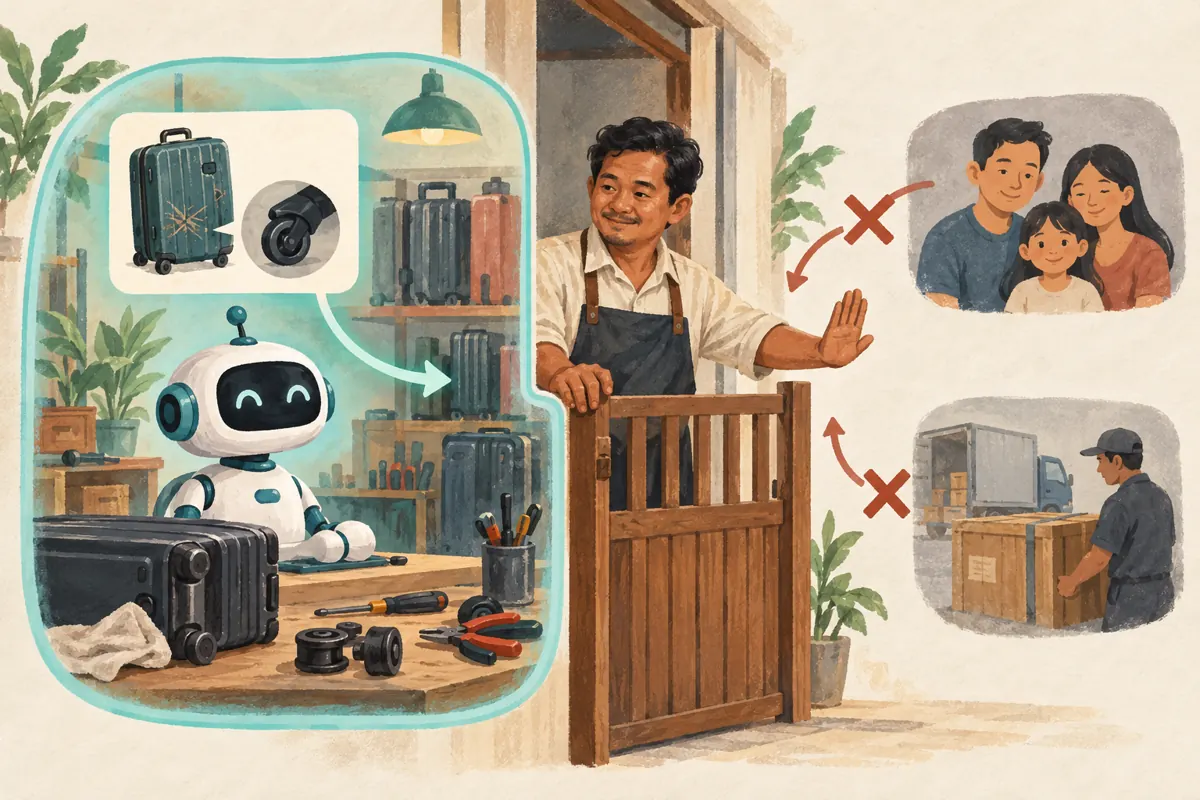
A shop owner’s account may contain customer enquiries, family conversations, supplier negotiations and staff messages. Treat those as separate needs when selecting access. Start with the smallest useful set of chats and verify the exclusions. Choosing new conversations can be practical for an initial trial, but “new” describes conversation history, not whether the sender is a customer.
Likewise, excluding contacts may keep personal conversations outside automation while also excluding returning customers saved in the address book. Decide who will answer those enquiries manually. Telegram documents recipient controls covering existing chats, new chats, contacts, non-contacts and explicit exclusions: https://core.telegram.org/constructor/businessBotRecipients. Test both an included conversation and an excluded one before announcing the assistant publicly.
4. Request photographs that answer a repair question
For the hypothetical wheel enquiry, ask for a view of the whole suitcase and a close-up showing the wheel housing where it meets the case. Explain the purpose: the overall view helps identify the luggage style, while the detail helps the technician see the attachment. Ask customers to describe what happens when the suitcase rolls. A wheel that drags and a housing that separates may require different follow-up questions.
Keep the initial request manageable. Do not demand every possible angle, a delivery address and payment details before anyone has assessed the problem. Invite customers to remove luggage tags and travel papers from the frame. If a useful detail requires opening a lining or removing a component, leave that request to the technician rather than automatically asking customers to dismantle the case.
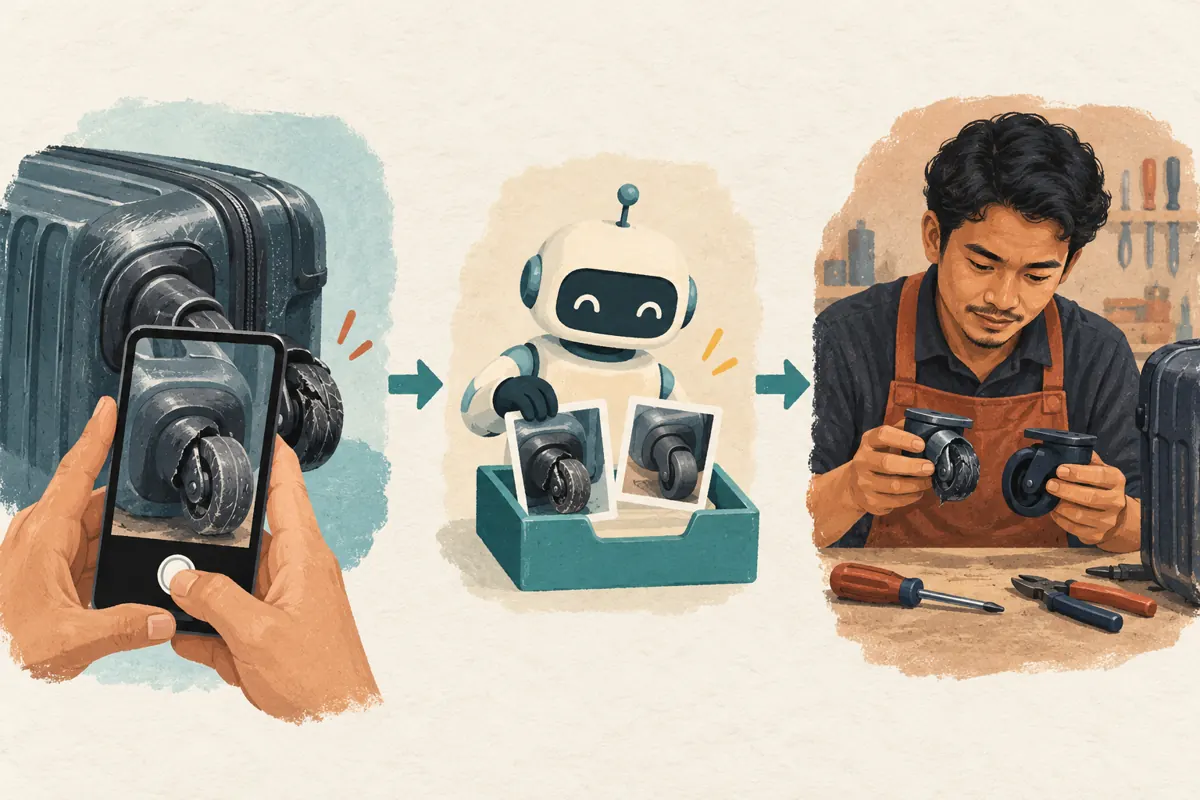
5. Make automated acknowledgements unambiguous
A hypothetical opening message could say: “This automated assistant collects repair details for our team. Please send a whole-case photo, a close-up of the damaged wheel and your requested completion date. A technician will confirm whether we can help. Sending photos does not reserve a repair slot.” Have a fluent Khmer-speaking staff member prepare and review the customer-facing Khmer version if that is the shop’s normal service language.
After receiving the material, the assistant should acknowledge only what it actually received. “Your photos are ready for staff review” is appropriate only if the handover genuinely occurred. Avoid “approved,” “booked” or “ready tomorrow” unless a person has established those facts. Ask customers their preferred language rather than treating an English product name, a profile name or a short greeting as reliable evidence.
6. Build a handover that someone owns
Set explicit reasons for human review: an uncertain part match, an unreadable photograph, a complaint, a price negotiation, an approaching travel deadline or a request to speak to staff. The assistant should stop asking routine questions once a human response is needed. A customer who has already explained a broken mounting plate should not be trapped in repeated requests for another wheel photo.
Assign a staff member to check the waiting enquiries during stated working periods. The handover summary should preserve the customer’s wording where it matters, distinguish requested timing from confirmed timing and identify missing information. Telegram documents per-chat pause and disconnection controls for connected bots; ask the provider to demonstrate how staff takeover uses the available controls. Technical support does not itself guarantee a smooth handover: https://core.telegram.org/api/bots/connected-business-bots.
7. Understand what access means for customer material
Telegram’s privacy policy says a connected third-party bot can access messages, media and files in private chats it is allowed to manage. Depending on granted permissions, it can also act on the account’s behalf. Read the provider’s own data practices before including customer conversations. Ask who operates the service, what it retains and how staff can request deletion of stored material. Telegram’s relevant explanation is in section 6.5: https://telegram.org/privacy.
For a repair enquiry, photographs of the case and the requested date are usually a better starting point than identity documents or travel itineraries. Collect collection or delivery details later, when needed for an agreed arrangement. Tell customers that automation is involved and provide a clear route to a person. Do not promise that disconnecting a bot erases copies already retained by its operator.
8. Test awkward enquiries before promoting the flow
Use staged conversations with staff and dummy photographs. Try a clear wheel enquiry, a blurred image, a Khmer voice message, an English question, an unrelated product request and a customer asking for urgent completion. Check whether unsupported input reaches a person instead of producing an invented diagnosis. Test a returning contact as well as a new sender, because the access rules may treat them differently.
Include corrections. In a hypothetical test, a customer first asks for wheel replacement, then explains that the handle also sticks. The handover must retain both issues without claiming either is repairable. Also test provider downtime and staff takeover. Record the expected response, actual response and correction needed. Repeat the failed cases after changes; do not approve the flow merely because its simplest greeting works.

9. Separate SMM catalogue labels from bot functionality
The supplied bong-views.com catalogue includes the exact public service name “Telegram Ads Click - [For Bot]”. Its description is empty. The title alone does not establish advertising placement, targeting, visitor origin, billing mechanics or whether it supports the shop’s proposed destination. It also supplies no evidence that the service builds, connects or maintains an enquiry assistant. Obtain the current written service details before considering a purchase.
A connected assistant handling the shop’s private conversations and a standalone bot destination are different customer entry points. Do not assume a service labelled for a bot accepts the shop profile or a channel post. If the accepted target and deliverable remain unclear, leave the order unsubmitted. Purchased engagement is not evidence of genuine interest, completed repairs, ad delivery or Cambodian users, and it should never be presented as customer demand.
10. Match the promotional promise to the actual response
A useful promotional post shows the kind of damage the shop can assess and explains what customers should send. In the hypothetical workshop, the invitation might be to request a wheel-repair assessment, with a clear statement that fit and timing require confirmation. Use a sample suitcase owned by the shop for demonstration photographs. Ensure the advertised contact route reaches the tested conversation flow.
Common mistakes include advertising instant quotations when the assistant only collects images, claiming round-the-clock repair support because automated replies run overnight, and leaving staff unaware that promotion has started. Another mistake is sending every enquirer through automation even when a person is already handling the case. Before increasing promotion, confirm that someone can review the waiting work and correct misleading replies promptly.
11. Review the quality of enquiries before expanding
Keep a simple operational record of whether the technician received usable photos, whether the customer understood the next step and whether the case reached a person when needed. Separate incomplete enquiries, unsuitable repair requests, accepted jobs and completed work. A completed intake conversation is not a sale. If a customer voluntarily explains where they found the shop, record that statement without treating it as independently verified attribution.
Review recurring confusion with the technician. If customers repeatedly send only the wheel tread, improve the example photograph and the request for the housing view. If they interpret an acknowledgement as a booking, rewrite that message before spending more on promotion. Expansion makes sense when the enquiry process reliably helps staff decide what to do next, and the shop has the capacity to respond.
Frequently asked questions
Does connecting a Telegram bot require Premium?
Telegram’s current connected-business-bot documentation says connection does not require Premium, and its May 2026 announcement directs users to Settings > Chat Automation. A third-party provider may still charge for its own service. Confirm those terms separately from Telegram account features: https://core.telegram.org/api/bots/connected-business-bots.
Can the assistant quote a repair price from a photograph?
Only give it quoting responsibilities that the shop can substantiate and supervise. For this workflow, leave quotations to the technician because a photograph may not show the mounting condition or required part. The assistant can collect the information needed for a quote without inventing a price or implying that inspection is complete.
What if customers send Khmer voice messages?
Test the selected provider with realistic sample messages before promising support. Do not assume that operating inside Telegram gives the assistant reliable Khmer transcription or understanding. If it cannot process a message confidently, acknowledge the limitation and hand the conversation to a Khmer-speaking staff member without forcing the customer to restart.
Should we promote the assistant itself or the repair service?
Lead with the customer’s repair problem and explain how to request an assessment. Automation is useful when it reduces missing information and makes the next step clear. Customers still need to know who will review their case, what remains unconfirmed and how to reach a person.
What should happen if the bot makes an incorrect promise?
Have a staff member promptly correct the statement in the affected conversation and explain the actual repair status. Pause automation for that case while resolving it. Identify which instruction or missing information caused the error, test the correction and review similar recent enquiries before resuming the same automated response.
Explore the current service catalogue, create an account, or ask a specific question through support tickets.
- Telegram: Guest AI Bots, Bot-to-Bot Chats, Chat Automation and More
- Telegram API: Connected Business Bots
- Telegram API: Business Bot Recipients
- Telegram Privacy Policy — Business Chatbots
Prepared with AI assistance. Illustrations explain the workflow and do not represent customer results.